
TRENCHLESS INSIGHTS / GCC INFRASTRUCTURE
Mechanical Point Repair for Localized Pipeline Defects
Engineering better access. Restoring network performance.
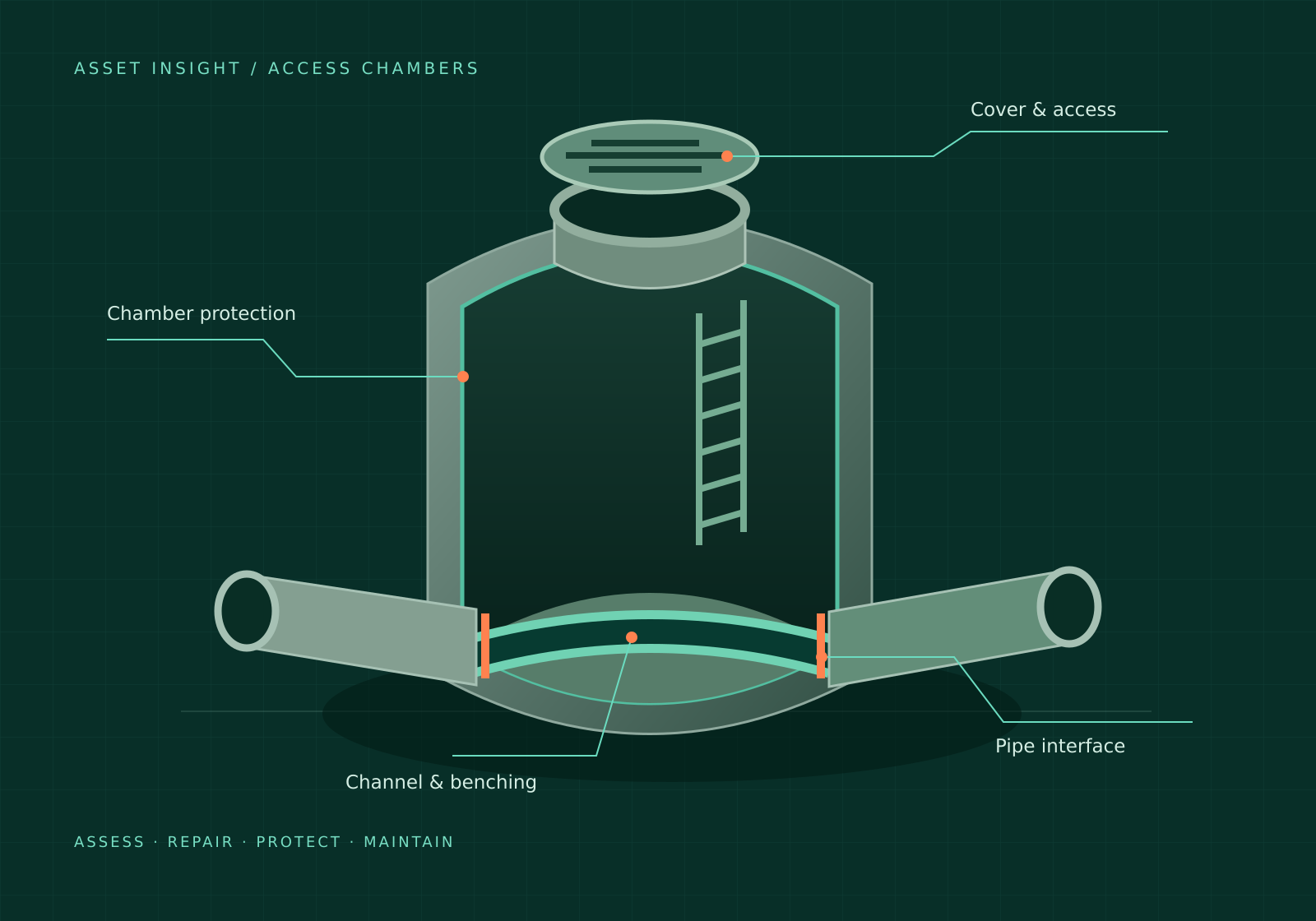
Access chambers and manholes are essential access points within sewer, drainage, water and utility networks. When these structures deteriorate, they can become a source of infiltration, corrosion, safety concerns and repeated maintenance. A well-designed rehabilitation program restores structural performance while improving access for inspection, cleaning and future trenchless works.
01
Why Access Chambers Need Rehabilitation
Chambers are exposed to aggressive wastewater environments, groundwater, traffic loading, temperature changes and repeated maintenance activity. Over time, concrete can crack or spall, reinforcement can corrode, joints can leak and benching or channels can lose their intended hydraulic profile.
In fast-growing Gulf cities, chambers may also need to accommodate network upgrades, larger flows, new pipe connections or revised maintenance requirements. Rehabilitation is therefore not limited to cosmetic repair; it can include engineering redesign of the chamber layout and access arrangement.
02
Condition Assessment and Engineering Review
A successful project starts with a structured condition assessment. Typical inputs include visual inspection, dimensional survey, CCTV information from connected pipelines, evidence of infiltration, corrosion mapping, structural defects, access limitations and the condition of covers and frames.
The engineering review should consider chamber geometry, pipe invert levels, hydraulic flow, confined-space access, traffic loading and compatibility with planned pipeline rehabilitation. Where BIM or survey data is available, the existing chamber can also be incorporated into a coordinated digital model to reduce clashes during upgrades.
03
Typical Chamber Redesign and Rehabilitation Scope
Depending on the asset condition, the scope may include structural concrete repair, crack sealing, joint treatment, corrosion-resistant coatings, waterproofing, channel and bench reconstruction, cover and frame replacement, ladder or access improvements, new pipe penetrations and chamber resizing.
For sewer and wastewater environments, material selection should consider chemical exposure and long-term adhesion to the substrate. Surface preparation, moisture conditions and application quality are critical to the performance of coatings and repair mortars.
04
Integration with Trenchless Pipeline Rehabilitation
Access chambers are often the launch, retrieval or working points for CCTV inspection, cleaning, CIPP installation, patch repair and mechanical point repair. Redesigning a chamber before or during pipeline rehabilitation can improve installation efficiency and reduce the need for additional excavation.
An integrated approach also helps ensure that the chamber-to-pipe interface is properly sealed. This is particularly important where groundwater infiltration or root intrusion has been identified at connections.
05
Benefits for GCC Infrastructure Projects
For municipalities, developers, utilities and industrial operators in the UAE, Saudi Arabia, Qatar, Kuwait, Oman and Bahrain, chamber rehabilitation can reduce road excavation, reinstatement work and disruption to occupied sites. It can also improve asset accessibility in dense urban areas where open-cut reconstruction is difficult.
When combined with inspection and trenchless pipeline repair, chamber rehabilitation supports a lifecycle approach: repair the defects that matter, improve future access and extend the usable life of the network instead of replacing every component.
06
Applications
Typical applications include municipal sewer networks, stormwater drainage, water utilities, industrial wastewater systems, utility corridors, airports, ports, residential developments, commercial districts and oil and gas facilities.
07
Our Engineering Approach
A practical chamber rehabilitation strategy should match the repair method to the actual defect and operating environment. The objective is to create a maintainable, durable access point that works with the surrounding pipeline system and supports future inspection and rehabilitation activities.
Frequently asked questions
What is access chamber rehabilitation?
It is the repair or redesign of an existing manhole or underground chamber to restore structural condition, reduce leakage or corrosion, improve hydraulic performance and provide safer maintenance access.
Can a chamber be rehabilitated without complete reconstruction?
Yes. Many defects can be addressed through localized structural repairs, coatings, waterproofing, sealing and access modifications, subject to an engineering assessment of the existing structure.
Can chamber rehabilitation be combined with CIPP lining?
Yes. Coordinating chamber works with CIPP or other trenchless rehabilitation methods can improve access, sealing and overall network performance.
Which GCC projects can benefit from chamber redesign?
Municipal, utility, industrial, residential and major infrastructure projects can benefit, particularly where excavation, traffic disruption or service downtime must be minimized.
Plan your next rehabilitation project.
Need a trenchless rehabilitation solution for your pipeline or underground infrastructure project in the GCC? Contact our engineering team to discuss inspection findings, repair options and the most suitable rehabilitation approach for your asset.
Discuss your project