TRENCHLESS INSIGHTS / GCC INFRASTRUCTURE
Patch Repair for Pipes: Materials, Methods & Benefits
Engineering better access. Restoring network performance.
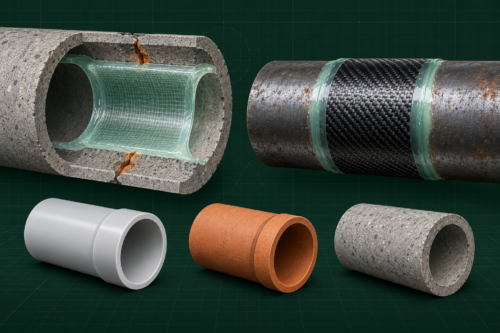
Patch repair for pipes targets a damaged section rather than replacing or rehabilitating the entire pipeline. The approach may involve an internal short liner, an external composite reinforcement, or another localized repair system selected for the defect.
The starting point is a clear assessment of the problem. A leaking joint, a corroded wall, and a fractured pipe may require different solutions, even when they occur in pipes of the same material.
01
What Is Pipe Patch Repair?
An internal patch typically bridges a localized defect from within the pipe. External composite repairs reinforce a damaged area from outside using a designed combination of reinforcing fabric and resin.
Trelleborg offers sectional short-liner systems for wastewater and sewer pipelines, while Advanced FRP Systems describes internal and external composite solutions for industrial piping. These are distinct repair approaches with different application requirements.
02
Patch Repair for Different Pipe Materials
Pipe repair planning should cover the full range of materials found in a network. However, “all types of pipes” describes the scope of assessment—not a guarantee that one patch product suits every pipe.
Pipe repair planning should cover the full range of materials found in a
network. However, “all types of pipes” describes the scope of assessment—not
a guarantee that one patch product suits every pipe.
| Pipe Material | Main Questions Before Selecting a Repair |
|---|---|
| Carbon steel and stainless steel | What is the remaining wall condition, and what reinforcement is required? |
| Cast iron and ductile iron | Is the defect localized, and what condition does the surrounding pipe show? |
| Concrete and reinforced concrete | What is the extent of cracking, deterioration, or exposed reinforcement? |
| Vitrified clay | Are fractures, displaced joints, or surrounding pipe damage present? |
| PVC and ABS | Does the proposed system have documented compatibility with the pipe? |
| HDPE and polypropylene | How will the repair achieve sealing, restraint, or bonding on the selected plastic? |
| GRP and other composite pipes | Is the proposed resin and reinforcement compatible with the existing laminate? |
| Copper, galvanized steel, and other metals | Does the repair suit the material, diameter, and operating service? |
This material schedule provides a useful basis for discussing suitability
with the repair supplier. Acceptance should follow the selected system’s
documentation and a project-specific assessment.
03
Internal Short-Liner Repairs
Internal short liners are used for localized rehabilitation within wastewater and sewer pipes. Trelleborg’s DrainPacker method uses resin and glass-fiber reinforcement, installed with packer equipment. Its published information identifies applications across several pipe materials, while distinguishing a close-fitting repair in HDPE from bonding to other substrates.
For a proposed internal repair, request confirmation of the defect coverage, finished internal profile, connection clearances, and inspection requirements. Nearby branches should also be identified before the repair position is finalized.
04
External Composite Pipe Repairs
External composite repairs provide another option where the outside of the pipe is accessible. Advanced FRP Systems describes engineered carbon-fiber systems for damaged or corroded piping, including selected through-wall failures.
Its process can include surface preparation, leak mitigation where necessary, filling pits and voids, installing a barrier where required, and applying the designed composite reinforcement and protective finish.
An external repair proposal should state the repair dimensions, reinforcement arrangement, material system, installation conditions, and intended service requirements.
05
Selecting the Right Repair Method
Before comparing products, prepare a repair brief that records:
Pipe material, diameter, and wall condition.
Defect type, dimensions, and location.
Internal pressure or gravity-flow service.
Operating temperature and conveyed medium.
Available internal or external access.
Required repair life and acceptance criteria.
The brief should also establish whether the objective is sealing, structural reinforcement, or both. A proposal should explain how the selected system meets that objective.
06
Inspection and Quality Documentation
Agree on the inspection and handover requirements before installation. Request records identifying the repair location, materials, preparation, installation conditions, and completed checks.
For internal work, include a clear record of the finished repair position. For external work, request documentation of the installed reinforcement and protective finish. The final package should demonstrate compliance with the agreed repair specification.
Frequently asked questions
Can patch repair be used on all pipe materials?
Different systems address different materials. Compatibility and suitability must be confirmed for the exact pipe, defect, and operating conditions.
What is the difference between an internal patch and an external wrap?
An internal patch treats a section from inside the pipe. An external composite wrap reinforces it from outside. The available access and repair objective help determine which approach to assess.
Can patch repair be used on pressure pipes?
Selected engineered composite systems address industrial piping applications. Pressure-service suitability must be established by the repair design; it should not be assumed from a sewer patch product.
Does patch repair always avoid excavation?
Access must be evaluated for each project. An internal proposal and an external proposal may require substantially different enabling works.
When should replacement be considered?
Request a comparison with replacement when the assessment identifies extensive damage, uncertain surrounding pipe condition, or requirements the proposed patch cannot demonstrate it will meet.
Plan your next rehabilitation project.
Need a trenchless rehabilitation solution for your pipeline or underground infrastructure project in the GCC? Contact our engineering team to discuss inspection findings, repair options and the most suitable rehabilitation approach for your asset.
Discuss your project