
TRENCHLESS INSIGHTS / GCC INFRASTRUCTURE
Access Chambers: Practical Solutions for Underground Utility Networks
Engineering better access. Restoring network performance.
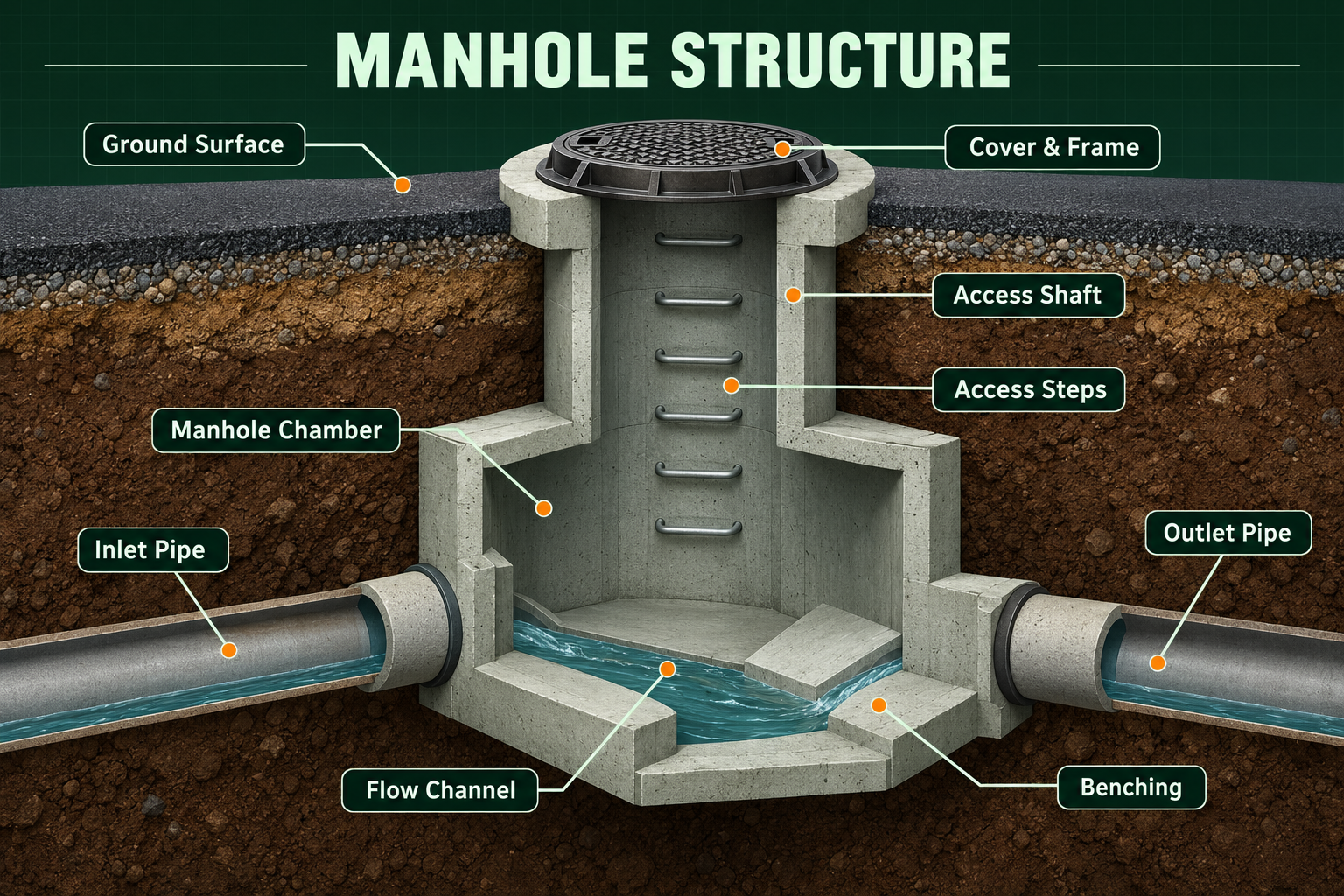
Access chambers provide designated points for reaching underground services. They help organize access within infrastructure networks and allow maintenance teams to work at planned locations.
For designers and contractors, selecting a chamber involves more than choosing its dimensions. The chamber body, duct connections, cover, frame, and surrounding construction need to form a coordinated installation.
01
Structural and Non-Structural Access Chambers
EJ offers both structural and non-structural underground chamber systems. Its product range includes NEXUS™ structural chambers and DATUM™ non-structural chambers, designed for use with compatible access covers and frames.
This distinction should be addressed early in the specification. Project teams should establish how loads will be supported and request installation details appropriate to the chosen system. Similar-looking chambers should not be assumed to have interchangeable structural capabilities.
02
Modular Chamber Construction
Modular systems allow chamber depth to be assembled from individual sections.
EJ’s catalogue describes NEXUS™ as a twin-wall polypropylene system assembled in 150 mm increments. It includes preformed duct entry options and is described as providing structural strength without a concrete surround, subject to the applicable product and installation requirements.
DATUM™ uses rotationally moulded, one-piece sections with an interlocking arrangement. The catalogue identifies applications including traffic signal installations and pedestrian crossings.
These product differences make it important to review the selected chamber’s documentation rather than applying one installation detail across an entire range.
03
Choosing the Correct Chamber Size
A useful chamber schedule should distinguish between the clear opening and the overall external dimensions. It should also record the required depth and the arrangement of incoming services.
Before selecting a size, consider:
The number and diameter of ducts.
The direction and elevation of each entry.
Space required for the intended maintenance task.
Compatibility with the proposed cover and frame.
Any allowance required for future connections.
04
Matching Covers and Frames
EJ identifies compatible cover options within its chamber ranges. For example, its catalogue links DATUM™ chambers with IDS ELITE composite covers and identifies NEXUS™ compatibility with specified multi-span cover arrangements.
The specification should therefore identify the complete assembly. Request confirmation of the cover, frame, chamber, and installation arrangement together, including the loading requirements for the intended location.
Other selection questions may include security, lifting arrangements, surface finish, and any required resistance to water entry. These should be defined as project requirements rather than assumed features.
05
Installation Planning
Before construction, prepare a coordinated installation detail covering the excavation, foundation, chamber assembly, service entries, frame support, and finished surface level.
The installation submission should answer practical questions:
Which manufacturer’s detail applies?
Are additional supports or surrounding construction required?
How will the frame align with the final paving?
How will duct entries be formed?
What checks are required before backfilling?
This approach gives the site team a clearer basis for construction and inspection.
06
Material and Sustainability Considerations
EJ’s published catalogue states that its underground chambers use recycled material and are recyclable.
For procurement, ask for documentation covering the exact product being supplied. Material declarations, installation instructions, and product identification should remain part of the project records.
Sustainability comparisons should also consider the complete installed solution, including additional construction materials, transport, maintenance access, and replacement requirements.
Frequently asked questions
What are access chambers used for?
They provide planned access points within underground service networks, supporting inspection and maintenance activities.
What is the difference between structural and non-structural chambers?
They use different approaches to supporting the installation. The required support arrangement should be confirmed from the selected manufacturer’s design and installation documentation.
Do all access chambers require concrete surrounds?
No. EJ describes NEXUS™ as a structural system that can be installed without a concrete surround under its specified conditions. This should not be generalized to other chamber types.
Can chamber depth be adjusted?
Modular systems provide sectional depth adjustment. The available increments and permitted assembly depend on the product.
Plan your next rehabilitation project.
Need a trenchless rehabilitation solution for your pipeline or underground infrastructure project in the GCC? Contact our engineering team to discuss inspection findings, repair options and the most suitable rehabilitation approach for your asset.
Discuss your project