
TRENCHLESS INSIGHTS / GCC INFRASTRUCTURE
Advanced Leak Detection for Underground Water & Pipeline Networks
Engineering better access. Restoring network performance.
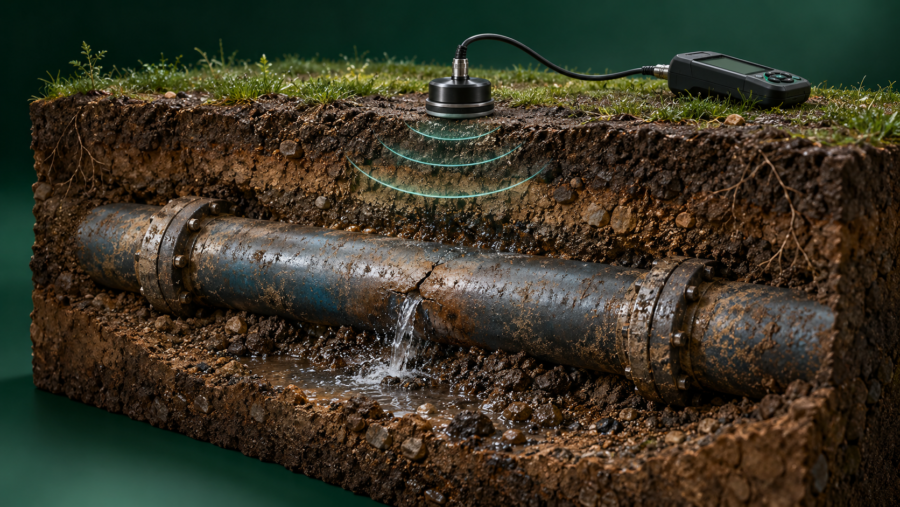
Underground leaks can waste water, undermine pavements and structures, increase operating costs and develop into major network failures. Effective leak detection aims to locate the source accurately before excavation or rehabilitation begins, allowing asset owners to select a targeted repair method instead of relying on broad replacement.
01
Why Accurate Leak Detection Matters
A visible wet area does not always identify the true leak location. Water can travel along bedding material, ducts or utility corridors before reaching the surface. This makes accurate diagnosis particularly important in urban environments, industrial facilities and large developments where unnecessary excavation is costly and disruptive.
02
Leak Detection Methods
The appropriate method depends on pipe material, diameter, pressure, access and the surrounding environment. Common approaches include acoustic correlation and listening, pressure analysis, step testing, tracer gas, thermal or moisture investigation, CCTV inspection for gravity networks and targeted internal inspection technologies.
For sewer and drainage systems, evidence of infiltration, displaced joints, cracks, roots or defective connections can often be identified through CCTV and flow observations. Pressure networks may require a combination of monitoring and acoustic techniques.
03
From Detection to Repair Planning
type are known, engineers can determine whether the problem is suitable for mechanical point repair, patch repair, CIPP lining, coating, joint sealing or conventional excavation.
This diagnosis-first approach reduces the risk of applying a full-length rehabilitation solution to a localized defect, or performing a local repair where the wider pipe condition requires structural lining.
04
Leak Detection in Gulf Conditions
GCC networks can operate in challenging conditions that include high temperatures, saline groundwater, aggressive soils, heavy traffic, rapid urban expansion and long utility corridors. These factors make asset condition data and accurate defect localization important for maintenance planning.
For large compounds, infrastructure corridors and industrial sites, leak detection can also be integrated into planned inspection programs, enabling maintenance teams to prioritize interventions by consequence and severity.
05
Applications
Leak detection services can support potable water networks, irrigation systems, firewater networks, process pipelines, district cooling systems, sewer and drainage networks, industrial facilities, residential developments and municipal utilities.
06
A Targeted Trenchless Strategy
The objective is not simply to find a leak; it is to generate reliable information for the next engineering decision. Combining leak detection with CCTV, mapping, survey data and trenchless repair technologies can shorten response time and improve the quality of rehabilitation planning.
Frequently asked questions
Can underground leaks be found without excavation?
In many cases, yes. Non-invasive and minimally invasive methods can narrow down or identify the leak location before excavation is considered.
Which method is best for pipeline leak detection?
There is no single method for every network. Selection depends on pipe material, pressure, diameter, access, fluid and site conditions.
Can leak detection be used before trenchless rehabilitation?
Can leak detection be used before trenchless rehabilitation?
Can leak detection be used before trenchless rehabilitation?
Can leak detection be used before trenchless rehabilitation?
Plan your next rehabilitation project.
Need a trenchless rehabilitation solution for your pipeline or underground infrastructure project in the GCC? Contact our engineering team to discuss inspection findings, repair options and the most suitable rehabilitation approach for your asset.
Discuss your project